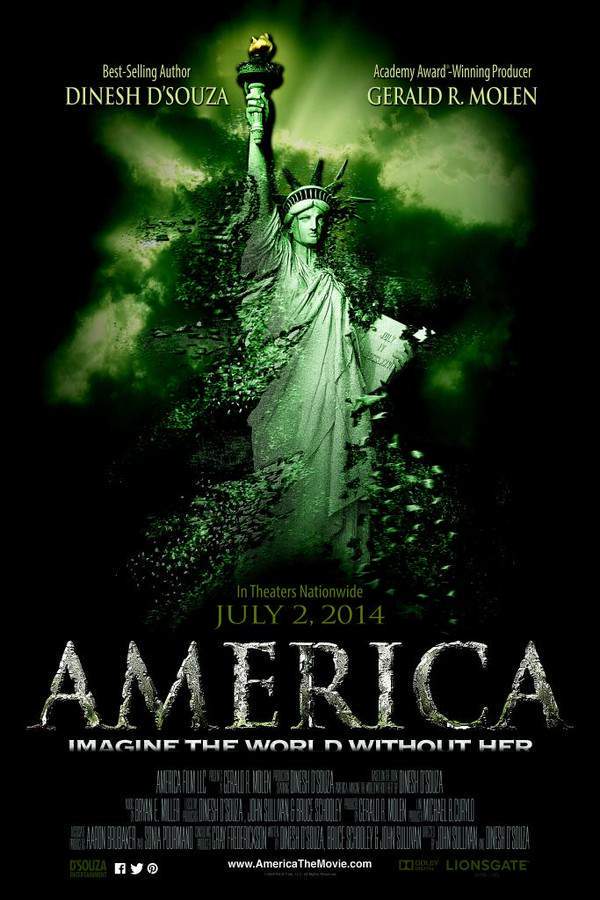
What Is America: Imagine a World Without Her About?
The premise of America: Imagine a World Without Her in 280 words, with nothing given away. The full story follows below.
An ambitious, combative documentary places Dinesh D’Souza and E. Michael Sullivan on a stage before an audience, using imagined versions of history to ask what the world might look like without the United States. Their opening thought experiment suggests an America that never emerged, or emerged fractured, inviting viewers to consider the nation’s distinctive influence. D’Souza also brings a personal perspective, framing himself as an Indian immigrant who chose America and admires the country he believes has served as an unusual force for good.
From this setup, the film turns a sweeping historical argument into an examination of national mythology. Questions about Indigenous displacement, the exploitation of African labor, economic inequality, and the influence of oil on foreign policy sit at the center of the inquiry. Interviews with academics, activists, politicians, and other public figures create a debate-like atmosphere, while D’Souza and Sullivan question both reverent accounts of American exceptionalism and blanket portrayals of the nation as uniquely culpable.
The storytelling blends direct presentation, historical illustration, archival material, and pointed counterarguments. Its tone is confident, cerebral, and deliberately provocative, with moments of humor sharpening a broader challenge to conventional interpretations of the past. The hosts do not approach history as a neutral ledger; instead, they ask what established narratives reveal, what they overlook, and how competing political ideas use the American past to justify their own ambitions.
At its heart, the documentary presents honest self-examination as a way of recognizing both America’s accomplishments and its failures. Rather than offering quiet comfort or simple condemnation, it encourages audiences to look closely at the foundations of national freedom and to consider how fragile those liberties may be when historical truth is obscured.
What Happens in America: Imagine a World Without Her?
The complete story of America: Imagine a World Without Her, from the first scene to the last, in 350 words (about 2 minutes). Spoilers throughout.
Spoilers ahead
The film begins by presenting counterfactual histories to illustrate a world without the United States—imagining scenarios where George Washington was killed during the Revolutionary War or the nation was permanently divided after the Civil War—arguing that such a world would be vastly worse off. D’Souza, an Indian immigrant, posits that while Americans traditionally viewed their country as a unique force for good, modern leftists are now attempting to “convince a nation to author its own destruction” and “unmake the America that is here now.”
The narrative directly challenges various “indictments” of American exceptionalism. It counters claims by figures such as Michael Eric Dyson, who suggests “thievery” was central to the American empire, and Ward Churchill, who labels the U.S. as a new “evil empire.” The film further asserts that the political trajectories of Barack Obama and Hillary Clinton were shaped by a culture of guilt and resentment regarding wealth inequality promoted by radicals like Saul Alinsky and Howard Zinn.
Central to the argument is the belief that America’s wealth was created rather than stolen. Using the purchase of Manhattan as an example, the film argues that individual industry, not the initial land acquisition, created the city’s billions in value. It suggests that while most nations were founded on conquest, the American pattern of wealth creation is a positive deviation from the global norm.
Regarding the treatment of Native Americans, the film argues that depopulation was primarily the result of accidental plagues rather than intentional genocide. It also features perspectives from individuals, including an interview with Ted Cruz, to contrast the “American Dream” against the desire to return to previous societal structures.
Finally, the film contends that slavery actually impeded American development. It highlights that the abolition of slavery was a uniquely Western achievement and describes the Declaration of Independence as a “promissory note” for liberty. By citing success stories like C.J. Walker, the first self-made female millionaire born to slaves, the film argues that the American system enables individual success, while economist Jagdish Bhagwati suggests there is no reason to be apologetic about the global embrace of the free market.
America: Imagine a World Without Her Timeline: Every Key Event in Order
17 key events in the order they happen, from “A World Without America” to “Free Enterprise and Living Standards”. 5 events name a place, across 5 locations.
- 1
A World Without America
Setting the stage for the film's arguments, D'Souza and Sullivan present counterfactual histories of the United States. In one scenario, George Washington is killed during the Revolutionary War, and in another the country is divided following a civil war. These thought experiments imagine a world without America, one the film presents as vastly worse off.
- 2
An Immigrant's Choice
D'Souza identifies himself as an Indian immigrant who chose America. He reflects on being impressed with what a unique force for good the country is, a view Americans have traditionally agreed with. This personal perspective frames his defense of the nation throughout the film.
- 3
The Left's 'New Story'
D'Souza claims that modern leftists are 'telling a new story' that contradicts traditional veneration for America. According to him, the goal of this narrative is to 'convince a nation to author its own destruction'. He argues it aims to 'unmake the America that is here now'.
- 4
Confronting the Indictments
The film takes on several 'indictments' made against the country and American exceptionalism. Among them are sociology professor Michael Eric Dyson's claim that 'thievery' was the 'critical element' for 'American empire', and historian Ward Churchill's assertion that the US is the world's new evil empire. D'Souza positions these claims as the targets his film sets out to rebut.
- 5
The Radicals Behind the Politicians
D'Souza argues that guilt and resentment regarding wealth inequality have deep roots in modern American politics. He points to 1960s Chicago radical Saul Alinsky, historian Howard Zinn, and others as promoters of these ideas. According to the film, this intellectual lineage helped shape the political careers of Barack Obama and Hillary Clinton.
When:1960s Where:Chicago
- 6
Manhattan and the Wealth Argument
D'Souza argues that America's wealth has been created rather than stolen. He notes that the $700 used to purchase colonial Manhattan from American Indians could buy many desolate parcels of land globally today. Individual industry, he contends, transformed that modest purchase into New York real estate worth billions.
When:Colonial era Where:Manhattan, New York
- 7
Conquest vs. Wealth Creation
The film observes that in Europe, India, and elsewhere, most countries have been founded on conquest. Against that backdrop, it presents the American pattern of wealth creation as far from the universal norm. This comparison is used to challenge the idea that America is uniquely guilty of taking what belongs to others.
- 8
The Conquest Ethic and the Plagues
The film argues that American Indians exhibited a 'conquest ethic' among themselves. It also claims that most of the American Indian depopulation during European colonization resulted from the accidental transmission of plagues, which had earlier devastated Europe, rather than from an intent to wipe out a people. These points are used to dispute narratives of deliberate genocide.
When:European colonization era
- 9
Leaving the Hunter-Gatherer Past Behind
Addressing the present day, the film argues that modern American Indians show little interest in returning to their hunter-gatherer past. It uses this to suggest that nostalgia for pre-colonial life is misplaced. The segment reinforces the movie's broader case against the notion of stolen land and wealth.
- 10
Ted Cruz on the Texas Revolution
In an interview segment, Senator Ted Cruz compares the Texas Revolution to the American Revolution. The comparison supports the film's framing of America's founding struggles as legitimate fights for liberty. Cruz's interview lends a political voice to the documentary's historical argument.
Where:Texas
Show the other 7 events of America: Imagine a World Without Her Hide the last 7 events
- 11
Reconquista vs. the American Dream
The film contrasts Reconquista advocate Charles Truxillo with an interviewed Tejano. While Truxilloadvocates the reclaiming of the Southwest, the Tejano says he has no desire to return to a poverty and crime-ridden Mexico. Instead, he expresses his wish to live the 'American Dream'.
- 12
Slavery as an Impediment
D'Souza argues that slavery impeded American development rather than boosting it. The film contends that slavery was an omnipresent phenomenon across most of human history. This framing counters claims that America's prosperity was built on stolen labor.
- 13
Abolition, Uniquely Western
According to the film, slavery's abolition was 'uniquely Western', setting it apart from slavery's long global history. It highlights the rarity of a 'great war fought to end slavery', pointing to the American Civil War as a singular example. This is presented as evidence of America's moral commitment to liberty rather than its unique guilt.
When:American Civil War era Where:United States
- 14
The Promissory Note of the Declaration
The film asserts that the Declaration of Independence essentially says 'liberty is the solution to injustice'. It describes the document as a 'promissory note' that was cashed throughout American history. Figures such as Martin Luther King Jr. are presented as heirs who fulfilled that promise.
When:1776
- 15
C.J. Walker's Self-Made Success
The film cites C.J. Walker, a black entrepreneur and daughter of slaves, as America's first self-made female millionaire. Her story is presented as an example of the type of individual success the American system allows. The film claims historians like Howard Zinn ignore such figures because they undermine their leftist narrative.
- 16
Embracing the Free Market
Columbia University economist Jagdish Bhagwati is shown declaring that the 'world is embracing the free market'. He adds that there is 'no reason for us to be apologetic' about it. His remarks reinforce the film's defense of America's economic foundations.
Where:Columbia University
- 17
Free Enterprise and Living Standards
In its concluding economic argument, the film outlines how somewhat free enterprise and consumer 'choice', rather than 'coercion', have raised living standards. It credits this system with making existing goods cheaper and creating entirely new ones. This closes the case that American wealth was earned through industry and innovation rather than theft.
What Kind of Film Is America: Imagine a World Without Her?
Hopeful in tone, with steady pacing and a complex story, going by the plot summary.
- Tone
- Hopeful
- Pacing
- Steady
- Story
- Complex
- Intensity
- Medium
- Ending
- Happy
A forceful, intellectually dense patriotic documentary that confronts painful American history through counterfactual scenarios and argues hopefully for the durability of liberty and individual achievement.
- assertive
- patriotic
- solemn
- reflective
- combative
- hopeful
- american exceptionalism
- national identity
- historical revisionism
- democracy and liberty
Content notes: slavery, indigenous dispossession and depopulation, civil and revolutionary war violence, racial exploitation, imperial foreign policy.
Quiz
How well do you remember America: Imagine a World Without Her? Test yourself on the story.